
Health Insurance for Self-Employed Individuals and Small Business Owners
If you are self-employed or you own a small business, you already know the difference between your health insurance and everyone else's. There is no employer contribution to hide behind. You pay the full premium yourself, usually with after-tax dollars, and the number does not get smaller as you get older.
This article is about a specific, practical alternative: private coverage through Ameristead Health on the Cigna PPO network. For the right applicant it produces some of the best rates and strongest coverage available in the individual and small-group market. But it is not available to everyone, and the gate is short and clear — a ten-question medical questionnaire. Understanding that gate is the whole point of this article.
Read this first: This is general educational information for consumers and business owners. It is not insurance advice, a quote, or a guarantee of eligibility or price. All eligibility decisions are made solely by the carrier. Rates change and vary by state, age, and household. Always confirm current details on the official plan documents and Schedule of Benefits before enrolling.
The Problem With the Default Option
Most self-employed people end up on an ACA Marketplace plan, and for many of them that is genuinely the right answer. But the economics change sharply depending on income. Premium tax credits phase out as your income rises, and a business owner with a decent year can find themselves paying the full unsubsidized premium for a plan with a high deductible — while still being responsible for a family's entire medical spend.
That gap is where private, medically underwritten coverage becomes interesting. It is priced on health rather than only on age and geography, so a healthy applicant can pay meaningfully less than an unsubsidized ACA plan for comparable or better benefits. The trade is direct and unavoidable: the carrier gets to look at your medical history, and it gets to say no.
Two Paths, and How You Find Out Which One Is Yours
Before any rate is quoted, an applicant completes a medical questionnaire. The current Ameristead Health form asks ten questions and asks that you answer every one on behalf of all applicants on the application.
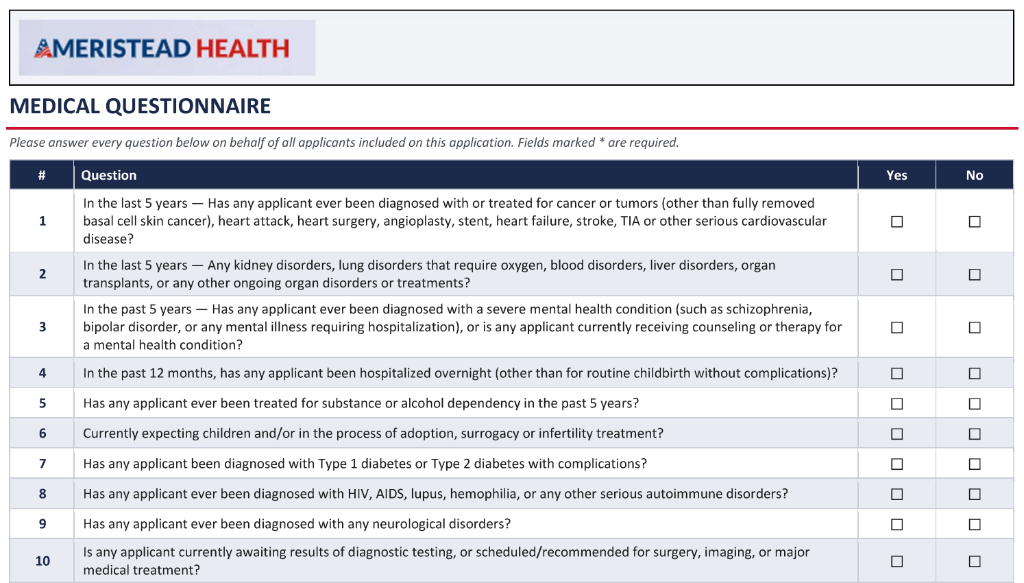
The 10 screening questions
- In the last 5 years — Has any applicant ever been diagnosed with or treated for cancer or tumors (other than fully removed basal cell skin cancer), heart attack, heart surgery, angioplasty, stent, heart failure, stroke, TIA or other serious cardiovascular disease?
- In the last 5 years — Any kidney disorders, lung disorders that require oxygen, blood disorders, liver disorders, organ transplants, or any other ongoing organ disorders or treatments?
- In the past 5 years — Has any applicant ever been diagnosed with a severe mental health condition (such as schizophrenia, bipolar disorder, or any mental illness requiring hospitalization), or is any applicant currently receiving counseling or therapy for a mental health condition?
- In the past 12 months, has any applicant been hospitalized overnight (other than for routine childbirth without complications)?
- Has any applicant ever been treated for substance or alcohol dependency in the past 5 years?
- Currently expecting children and/or in the process of adoption, surrogacy or infertility treatment?
- Has any applicant been diagnosed with Type 1 diabetes or Type 2 diabetes with complications?
- Has any applicant ever been diagnosed with HIV, AIDS, lupus, hemophilia, or any other serious autoimmune disorders?
- Has any applicant ever been diagnosed with any neurological disorders?
- Is any applicant currently awaiting results of diagnostic testing, or scheduled/recommended for surgery, imaging, or major medical treatment?
Questions reproduced as they appear on the Ameristead Health Medical Questionnaire. Answer every question for all applicants included on the application.
If you answer YES to any question
You are not eligible for this underwritten product. Do not treat that as a dead end — treat it as a clear instruction. Your path is an ACA policy, where you cannot be declined or charged more because of a pre-existing condition, and where every plan must cover essential health benefits.
An ACA plan is also the only route to premium tax credits, which can be substantial for a business owner in a lean year. If you have an ongoing condition, an ACA plan is generally the stronger financial choice regardless of premium.
If you answer NO to all ten
You can be considered for coverage through Ameristead Health. This is where the rate sheet gets genuinely competitive, and where the Cigna PPO network becomes the most important part of the offer: broad access, no referrals for specialists in most cases, and coverage that travels.
The rest of this article is about reading those rates honestly, because the cheapest premium is not always the cheapest plan.
The Plan Lineup
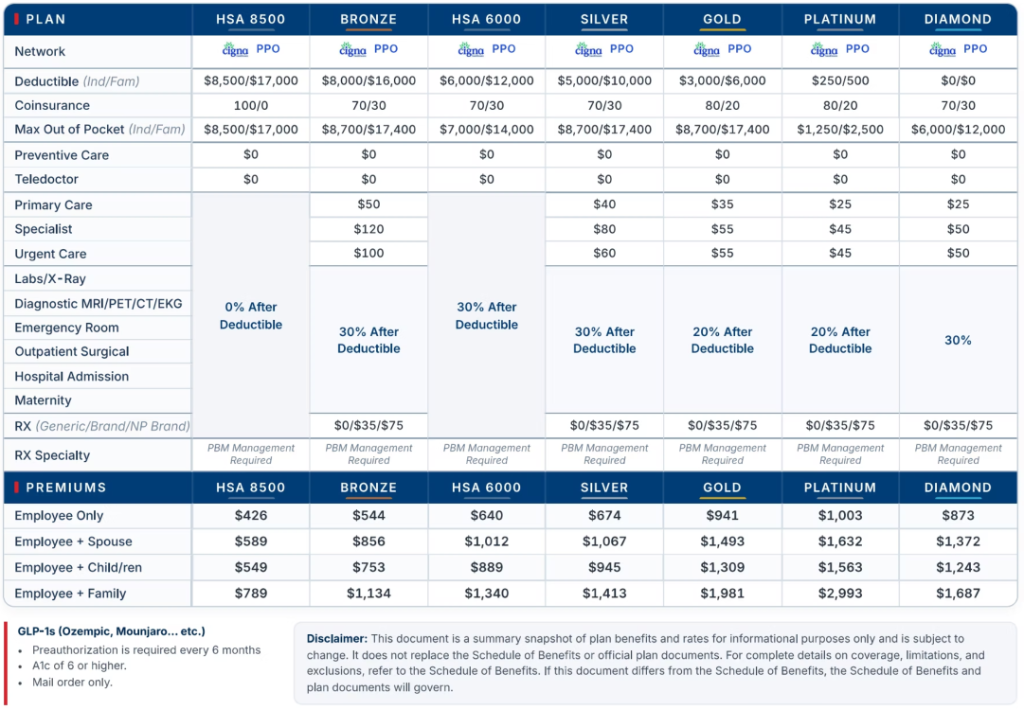
Seven plans are shown, all on the Cigna PPO network. They range from a high-deductible HSA-compatible design to a $0-deductible option, and the premium spread between them is wide enough that choosing well matters more than negotiating.
| Plan | Deductible (Ind / Fam) |
Coinsurance | Max Out of Pocket (Ind / Fam) |
Employee Only (per month) |
|---|---|---|---|---|
| HSA 8500 | $8,500 / $17,000 | 100 / 0 | $8,500 / $17,000 | $426 |
| Bronze | $8,000 / $16,000 | 70 / 30 | $8,700 / $17,400 | $544 |
| HSA 6000 | $6,000 / $12,000 | 70 / 30 | $7,000 / $14,000 | $640 |
| Silver | $5,000 / $10,000 | 70 / 30 | $8,700 / $17,400 | $674 |
| Gold | $3,000 / $6,000 | 80 / 20 | $8,700 / $17,400 | $941 |
| Platinum | $250 / $500 | 80 / 20 | $1,250 / $2,500 | $1,003 |
| Diamond | $0 / $0 | 70 / 30 | $6,000 / $12,000 | $873 |
HSA 8500 and HSA 6000 are labeled as HSA-compatible designs, which is worth confirming with the carrier if you intend to pair the plan with a Health Savings Account. Coinsurance is shown as the plan's share / your share.
What the Premiums Actually Look Like
The same seven plans, priced by household type. These are the monthly figures shown on the current sheet.
| Plan | Employee Only | + Spouse | + Child(ren) | + Family |
|---|---|---|---|---|
| HSA 8500 | $426 | $589 | $549 | $789 |
| Bronze | $544 | $856 | $753 | $1,134 |
| HSA 6000 | $640 | $1,012 | $889 | $1,340 |
| Silver | $674 | $1,067 | $945 | $1,413 |
| Gold | $941 | $1,493 | $1,309 | $1,981 |
| Platinum | $1,003 | $1,632 | $1,563 | $2,993 |
| Diamond | $873 | $1,372 | $1,243 | $1,687 |
Monthly premiums as shown on the current Ameristead Health rate sheet. Rates are subject to change and vary by state and the carrier's underwriting.
The Cheapest Premium Is Not the Cheapest Plan
Here is the trap. Sorting by premium points almost everyone at the HSA 8500, and for a healthy person with a fully funded savings account that is often correct. But premium is only half the bill. The other half is what you can be asked to pay in a bad year.
The table below adds the annual premium to the in-network out-of-pocket maximum for self-only coverage. That total is your realistic worst-case exposure, and it reorders the plans.
| Plan | Annual Premium | Max Out of Pocket | Worst-Case Year |
|---|---|---|---|
| HSA 8500 | $5,112 | $8,500 | $13,612 |
| Bronze | $6,528 | $8,700 | $15,228 |
| HSA 6000 | $7,680 | $7,000 | $14,680 |
| Silver | $8,088 | $8,700 | $16,788 |
| Gold | $11,292 | $8,700 | $19,992 |
| Platinum | $12,036 | $1,250 | $13,286 |
| Diamond | $10,476 | $6,000 | $16,476 |
Illustrative arithmetic only: monthly premium × 12, plus the self-only in-network maximum out of pocket. It ignores copays below the deductible, out-of-network care, and any care not covered by the plan. Your actual exposure will differ.
Three things this table tells you
- Platinum has the lowest worst-case year ($13,286) despite having the second-highest premium, because its $1,250 out-of-pocket cap is unusually low for this market. For someone who knows they will use care — or who simply wants a hard ceiling — that is the quietly strongest design on the sheet.
- HSA 8500 is the best pair with a savings strategy. It is the lowest annual premium and the second-lowest worst case ($13,612), and it is built to be paired with a tax-advantaged account. It is a poor fit for someone who cannot fund the deductible.
- Silver is the trap. It costs $2,976 a year more than HSA 8500 and has a higher out-of-pocket maximum ($8,700 versus $8,500). On these numbers it is the weakest value on the sheet for an individual, even though its name sounds like a middle-of-the-road choice.
The Diamond plan deserves a closer look
Diamond has a $0 deductible, which reads as the richest plan — but it carries 70/30 coinsurance and a $6,000 out-of-pocket maximum. That combination means you begin paying 30% of covered costs from the first dollar, and you can still reach $6,000. It is cheaper per month than Gold or Platinum, and it can be a reasonable choice for someone who expects steady small expenses rather than one large event. But it is not a low-exposure plan, and it is not automatically better than Platinum just because the deductible is zero.
Why the Cigna PPO Network Matters as Much as the Rate
A cheap premium on a narrow network is a false economy if your physicians are out of network. Every plan on this sheet uses the Cigna PPO network, which is the part of the offer that is hardest to replicate at this price point.
- PPO structure. You can generally see specialists without a referral and use both in-network and out-of-network providers, though out-of-network care costs more and may have separate limits.
- National access. Useful for owners who travel, have children at school elsewhere, or split time between locations.
- Predictable copays. Primary care, specialist, and urgent care visits carry fixed copays on most of the plans ($25–$50 range), which makes routine care easy to budget.
- Preventive care at $0. Every plan on the sheet shows $0 preventive care and $0 telehealth, which is the right place to have no friction.
Before you commit, verify your specific physicians, your hospital, and your prescriptions against the current Cigna directory for the plan you are considering. Network participation changes, and a directory check is worth the twenty minutes.
A note on GLP-1 medications: the rate sheet states that GLP-1 drugs (Ozempic, Mounjaro, and similar) require preauthorization every 6 months, require an A1c of 6 or higher, and are available by mail order only. If weight-management medication is central to why you are buying coverage, confirm those conditions with the carrier before enrolling rather than after.
What This Coverage Is Not
Being clear about the limits is more useful than being enthusiastic about the rates. This product is not an ACA Marketplace plan, and the differences are consequential:
- No premium tax credits. Because it is not Marketplace coverage, it does not qualify for subsidies. Compare it against an unsubsidized ACA premium, not a subsidized one.
- Medical underwriting is real. A “yes” answer means ineligibility on this application. There is no guaranteed-issue protection here.
- Pre-existing conditions. Underwritten products generally exclude or limit coverage for conditions that existed before coverage began. Read the exclusion provisions, not just the benefits grid.
- Essential health benefits are not guaranteed. ACA plans must cover a defined set of essential benefits. Private plans are not held to that standard, so check categories you specifically rely on — maternity, mental health, prescription tiers, and pediatric care in particular.
- Rate sheet is a summary, not the contract. The sheet itself says it does not replace the Schedule of Benefits or official plan documents, and that where they differ, the official documents govern.
How to Decide, Practically
- Answer the ten questions honestly and completely for every applicant who would be on the application. This single step determines which conversation you are having.
- If any answer is yes, go straight to the ACA route and look at your premium tax credit estimate before dismissing it. Subsidies can change the comparison entirely.
- If all answers are no, compare plans on worst-case exposure, not premium alone. Add annual premium to the out-of-pocket maximum.
- Check your actual network — physicians, hospital, labs, and your current prescriptions against the Cigna directory.
- Fund the deductible if you choose a high-deductible design. An HSA-compatible plan only works if the money is actually there when you need it.
- Re-shop every year. Underwritten rates and ACA subsidies both move. The right answer at 45 with a family is often not the right answer at 58.
Compare Your Options Side by Side
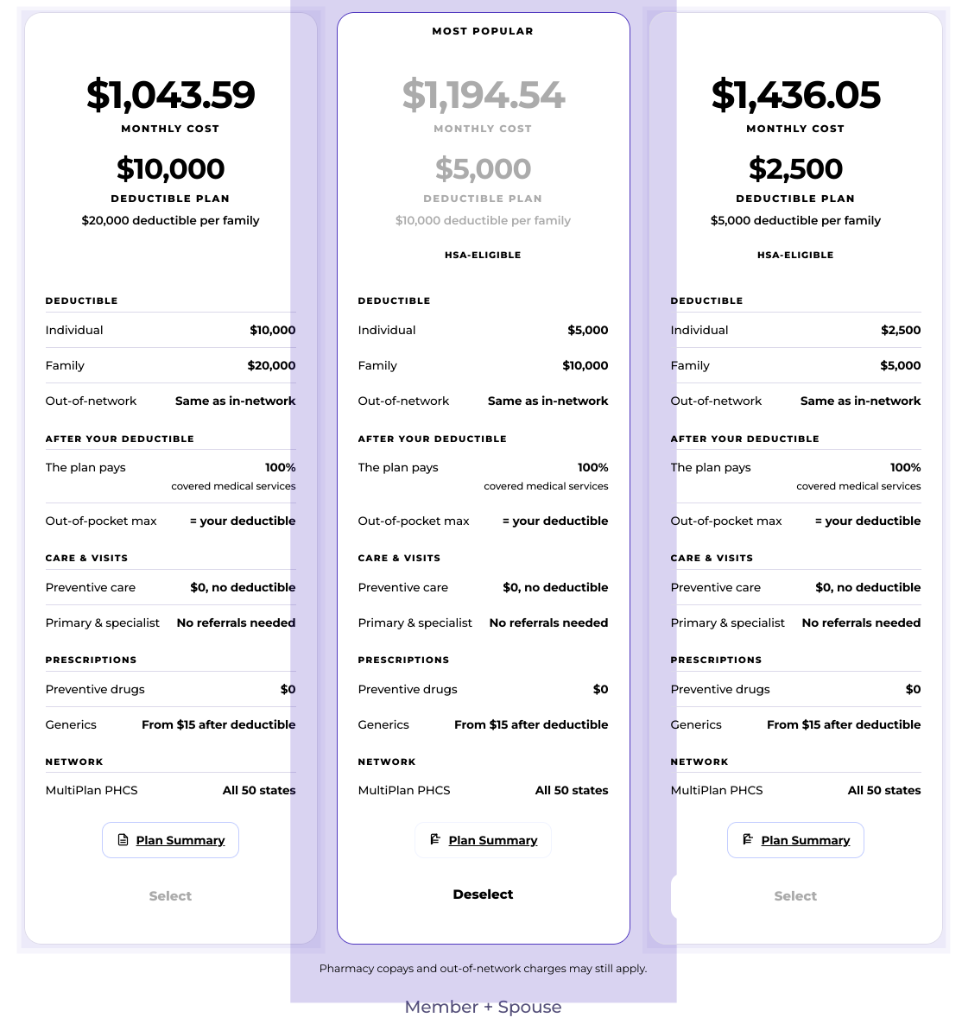
Whichever path you are on, the practical work is the same: put the plans next to each other and read them on the same lines. Below is an example of how a plan comparison lays out for Member + Spouse coverage — three deductible levels, the same core benefits, and the monthly cost clearly attached to each.
Read this comparison correctly
The screenshot above is a different product line from the Ameristead Health plans discussed earlier in this article. It uses the MultiPlan PHCS network rather than the Cigna PPO network, and these rates are for a specific household type. Its prices are higher than the Ameristead Member + Spouse rates shown above.
That is the point of comparing rather than assuming: two product families can both be legitimate and still land in very different places for the same household. Which one is better for you depends on your health history, your household, your state, and your budget — not on which name you happened to see first.
What to put on the same line, every time
- Monthly cost for your actual household tier — not the headline "starting at" figure, which is usually a single person or a younger age band.
- Individual and family deductible, and whether out-of-network counts toward the same number.
- What the plan pays after the deductible, and whether the out-of-pocket maximum is separate from it or the same as it.
- HSA eligibility, if you intend to pair the plan with a savings account.
- The network — Cigna PPO, MultiPlan PHCS, or another — and whether your physicians and hospital are actually in it.
- Prescription tiers, including where your current medications fall and whether prior authorization is required.
One caution on screenshots: rates change, and a plan example captured on one date may not be available or priced the same when you enroll. Use any comparison — including the ones in this article — to understand how to read a plan, then confirm live numbers before you apply.
Self-employed or running a small business?
Halo Health Advisors works with individuals, families, and business owners to compare private coverage, ACA Marketplace plans, HSA strategies, and health sharing — so you can see the real trade-offs side by side before you commit.
Compare Health Plans Contact UsDisclosure: Plan comparison and enrollment links on this site are advisor/referral links. Halo Health Advisors may receive compensation if you enroll through them, at no additional cost to you. Rates and benefits shown are taken from the current Ameristead Health summary sheet, are subject to change, and may vary by state, age, and household. This document is a summary for informational purposes only; it does not replace the Schedule of Benefits or official plan documents, and where they differ, the official documents govern. Eligibility is determined solely by the carrier. This article is general education and is not insurance, tax, legal, or medical advice. Cigna, Ameristead Health, and Marpai are trademarks of their respective owners.